
Smoke research becoming practical guidance

Updated: Apr 1
From laboratory studies to field applications, BNHRC smoke research is helping shape practical resources to support firefighter safety and air-quality management.
Above: UOW scientist deploying an open path FTIR spectrometer to measure smoke composition at hazard reduction burns in NSW.
Thanks to BNHRC scientists, emergency management agency representatives now have a stronger understanding of the chemical composition of bushfire smoke in NSW. The next phase of the research will focus on translating those findings into practical action.
The smoke research projects were co-designed with Fire and Rescue NSW (FRNSW) and the NSW Department of Climate Change, Energy, the Environment and Water (DCCEEW), and will help to improve air quality forecasting and strengthen safety guidance for firefighters.
The project team, coordinated by Prof Clare Murphy and Dr Max Desservettaz at the University of Wollongong, met in February 2026 to review progress on this research and to plan the next steps to translate findings into practical guidance.
A key focus was on upcoming laboratory experiments in Germany using a specialised smoke chamber to better understand how bushfire smoke behaves in the atmosphere. By comparing experimental results with existing air-quality models, the team hopes to improve predictions of smoke movement and chemical composition.
This work complements ongoing modelling studies in Australia that analyse emissions from both bushfires and prescribed burns, including comparisons with field data from recent monitoring campaigns.
The team also discussed recent findings about emissions from different fire phases, and plans to refine emission factors and forecasting approaches using these new findings.
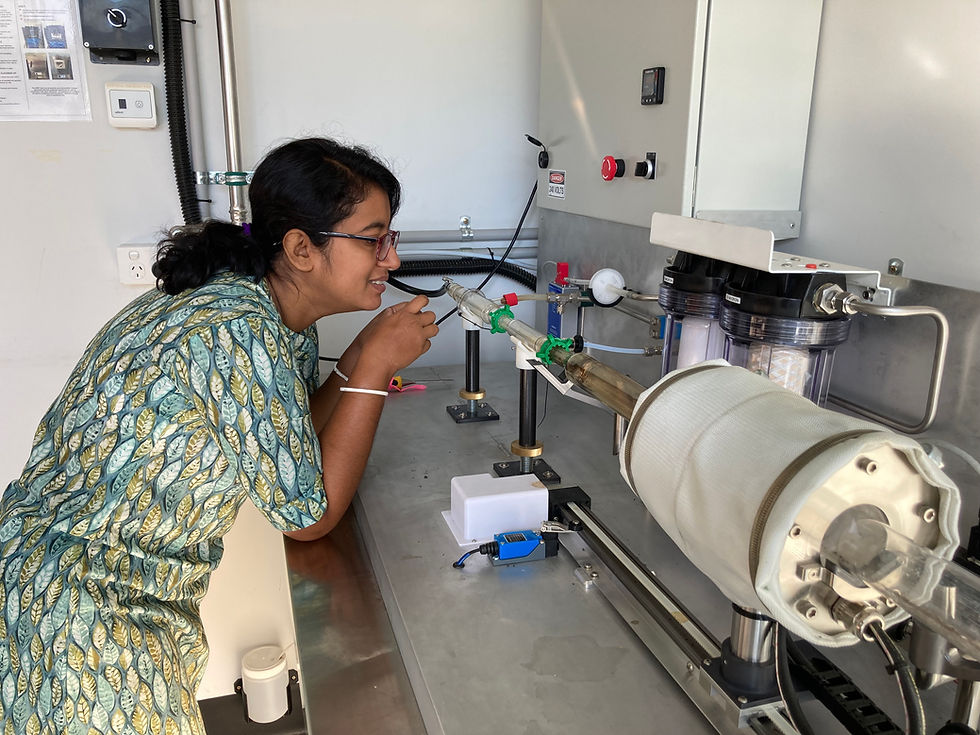
Additional experimental burns scheduled at the University of Tasmania’s FireLab (left) will analyse smoke released from peat and other fuels to improve understanding of health risks and environmental impacts.
Representatives from AFAC (the Australia and New Zealand Fire and emergency services Council) highlighted the real-world challenges firefighters face. For example, managing smoke exposure and safely decontaminating protective clothing and equipment after operations is difficult, especially in remote areas with limited washing facilities.
Turning research into firefighter information

The next step is to translate findings into usable information for emergency responders.
The project team is developing accessible educational resources rather than prescriptive rules, including short expert videos, practical fact sheets and a dedicated website bringing together research papers, safety advice and guidance on bushfire smoke issues.
These may include, for example, respirator use, carbon-monoxide monitoring and reducing cross-contamination.
These materials will be piloted with partner emergency management agencies and shared more broadly through national emergency-management networks, helping ensure that the latest bushfire smoke research supports safer operations on the ground.
Learn more about the 'RUSH' project here.


Comments